How this started
Hi! This is a self-made project to learn about what I want to do in the world. Heading into junior year, I want to get a better grasp on my surroundings, and what better way to do that than by talking to people? I have been interviewing people to learn about their lives and get a better understanding of my own.
This project started as a goal search for me, but you can use it however you want. Maybe you are curious about people. Maybe you just need something to pass the time. Either way, it is here.
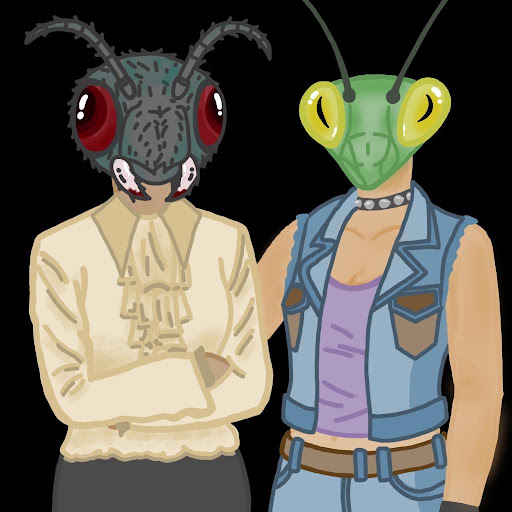
The name, “Insect Within,” comes from a friend who is obsessed with bugs. She knows everything about them. One of her favorite things to do is compare people to bugs by matching personality traits to species. We have had long conversations about which bug fits whom. She was a praying mantis, and I am a tarantula hawk, as shown by the cover image. Hence the name “Insect Within.”
After all, there were bugs before there were humans.
Conversation 01
The nurse working two jobs
On my floor, the nurse used to joke that every shift I followed her like a lost duckling. She was very patient, walking me through everything she did and explaining as she went.
She was a CNA working toward her RN, and somewhere between the tasks we had a conversation about work. She told me that after twelve-hour shifts she went straight to her second job as a gas station attendant until ten at night. Her day started at seven in the morning and ended fifteen hours later.
She was working hard to bring her son to the United States. He was three years old and living in Ethiopia, where she was from. She and her husband had immigrated first to build a foundation and then bring their son. She pulled out her phone and showed me a picture of him: a small boy with the biggest smile, wearing a little bow tie, standing with his hands on his hips. She missed him dearly and could not wait until the day he crossed that ocean.
That was her reason to keep working.
Conversation 02
The person who found the point after starting
She started with no plan at all. The first question was just, “Who is willing to hire me with my minimum qualifications?” Apple retail in 2014, under twenty dollars an hour. Then community college admissions, picked on purpose to avoid what she called “selling people student loans, selling people into debt.”
When COVID emptied the office, she trained every replacement while the new hires earned more. A college friend then pulled her into hospital talent acquisition, which felt like coming full circle. She built that program alone under a boss whose entire management philosophy was that whatever she did that year would be better than what they had the year before, so she should just do it.
The purpose, being the resource a first-generation student actually needs, showed up after the job did. Then it started driving every move after. “I was gonna say, it’s not over yet.”
Conversation 03
The surgeon, 52, who cures things
He had wanted to be a surgeon since he was five. But what made him a bariatric surgeon was sitting in on his chief’s office hours in Philadelphia and watching patients’ diabetes and high blood pressure vanish after surgery. Medical school had taught him to keep adding more and more medications. “Nobody taught me how to cure things. So this surgery cures things.” Medications manage. They do not cure, and they come with side effects. “I like this because it just takes disease away.”
He calls obesity “the real pandemic,” not just COVID. In America, one in two people is obese, and it drives diabetes, sleep apnea, hypertension, even cancers and fertility problems. “Once you get the weight off, the medical conditions go away and you don’t need medication.” Every step of his career has moved toward less harm for the patient, from open surgery to minimally invasive: less pain, fewer infections, faster recovery.
He grieves what the system is doing to patient care. Speaking anonymously, he told me private equity and administrators now control practices and hospitals. “We’re spending more healthcare dollars per person, but I think people are not getting the best care. I think patient care is suffering.” Then, quietly: “Don’t put that on my name.”
He knew exactly who he was talking to: an eleventh grader thinking about medicine, unsure about spending thirteen years on it. So he coached me straight, like he was getting the next generation ready. “I loved med school. I loved residency more. It’s tough. It’s challenging. You don’t know how much you enjoy it while you’re in it.” No varnish on the day-to-day either. The day before our interview, he had done three very challenging surgeries. Then came the payoff, plain: “It was a dream of mine to become a surgeon, and I am a surgeon. I’ve always wanted to do this all my life. And I’m doing it.”
And why, for someone still choosing: “We’re all God’s children, right? If you’re taking care of the sick, it’s kind of like God’s work, right?” Plus the warning, gently given: “Medicine’s changed quite a bit. Let’s be careful.”
Conversation 04
The dean, 59, who kept going anyway
She had a baby young, and she picked herself up anyway. She walked into NYU’s PhD program pregnant, too big for the seminar chairs, and she would wait until everyone else had filed out before hauling herself up out of them. Back then, her dates were the broke-student kind, where he would ask what the babysitter cost and hand her half.
“Why? Who does that?”
Her wedding came at thirty-five, four months pregnant, in a church with no air conditioning. The organist’s student froze halfway down the aisle. Her father’s heart could not take the heat, so they cut the ceremony short and celebrated in a Knights of Columbus basement. Cookie table and all.
She kept going through the doctorate, raising two kids, and a divorce. Looking at who she became: three degrees ending in a PhD, then a steady climb through academic leadership. She held faculty roles and an associate deanship, and now works in the dean’s office of a major university’s continuing studies school, where she leads hundreds of staff and thousands of adult learners. She steered the school through COVID, built new degree programs, and still publishes on the future of education. Her creed as an educator is care for the whole person: accessibility, affordability, inclusivity.
One honest note on how I got this: her conversation happened alongside Tom’s. She walked into his interview partway through, and it turned into the two of them looking back together. What is above is her thread of it, kept separate the way the transcript keeps it. Eighteen months ago, at Christmas, the family watched decades of digitized home video together, including that wedding. Asked if she still likes him: “I still do.”
Conversation 05
Yes and no
Every move Tom made was about logistics, not dreams: tuition remission, a friend’s recommendation, wanting to live near people he liked. He photographed surgical cases and child-abuse evidence in Pittsburgh emergency rooms, then left because it was “80% selling yourself and 20% photography.” He took a law library job for the tuition break, earned the degree, moved to New York on New Year’s Eve 1986, and spent five years as a branch librarian, breaking up fights over the newspaper and calling the “library police.” The love of books and teaching was real. It just arrived after the choices, not before them.
My last question was always the same: “Are you happy with how things turned out?” He cried. He said no one had ever laid his life out in front of him like that. His answer: “Yes and no.” Glad for the life, the students, the people, but he wished he had chased his passions earlier and spent less of it earning money. “I was once married to this woman. She’s incredible.” His ex-wife was sitting beside him.
Conversation 06
Daughter
I met her in the hallway outside her father’s room, where she kept watch as he was recovering. She was tired in the specific way people get when they have been sitting in a chair too long. I sat next to her, hoping to provide some reprieve from the situation.
She told me about her days in college. She had signed up for an HR course at random, still trying to figure things out. Something about the course clicked with her, and the bachelor’s degree turned into a master’s. In the office, her nickname was “the Anchor,” as a joke about her height, since she stood at five foot two, but also because she was the one people could count on. She lit up talking about her coworkers, projects, and the career she has built over the years.
One of her regrets was what her ambition had cost her. She loved her parents, but ambition does not leave room for everything, and family was what got set aside. As we sat together in the hospital room, she told me the commitment she had made to herself: she would make time for the things that are important to her. Taking care of her mom and watching closely over her dad was her new purpose.